Start with the job
A factory buying remote support needs the supplier’s expertise. An unattended production shift also needs a service that can decide and act within agreed limits. The same equipment can support both arrangements.
Remote expertise or a dark factory?
Illustrative applications of the paper’s service types to a packaging line.
Remote experts
- The service
- A remote specialist investigates failed seals on a packaging line, checks the film specification, and changes sealing temperature with the plant’s approval.
- Human role
- The supplier’s specialist chooses the intervention. The plant grants control and can stop the change.
What it needs
Machine access and shared process data, with a service agreement defining control rights and escalation.
Dark factory
- The service
- For an unattended shift, a service sets sealing temperature and film tension from product dimensions and film specifications. It checks seal quality and adjusts within validated limits.
- Human role
- Engineers approve the operating limits. An exception pauses the affected line for a specialist to investigate.
What it needs
Reliable inspection and feedback, permission to change settings, and a tested recovery procedure. Responsibility for defective output must be agreed.
The paper describes complementary service types. A factory could handle routine adjustments autonomously and bring in remote experts for exceptions.
What the study adds
The taxonomy connects what a service delivers with who provides and uses it, the analytics behind it, and how it informs or acts. Remote management and autonomous operation emerge as distinct, compatible service types.
Several routes to smarter services
Remote management and autonomous operation can develop side by side.
Connected product
Data from equipment in use
Improve daily operations
Support the work customers already do.
Possible development paths
Manage products remotely
Can provide remote support and control, or information for additional users.
Let the service decide and act
Carry out actions within defined limits.
These paths can coexist: remote support can complement autonomous operation.
Complementary routes
- Upgrade existing equipment
- Add sensing and connectivity to the installed base.
- Help providers learn
- Use product data to inform the provider’s decisions.
Both connect to the product and support development across these services.
A practical starting point
Start with the service outcome, then specify who decides and who acts. For unattended operation, define which changes the service can make and when an expert takes over. For remote support, agree on access and control.
About the study
Research approach
We developed the classification by moving between research literature and descriptions of 100 implemented B2B smart services. Cases had to explain the customer value and how the service worked in practice. They covered several industries, including manufacturing, healthcare, and agriculture. We revised the categories through repeated rounds of coding and feedback from researchers.
Evidence and analysis
We tested whether other researchers could apply the categories to the same service descriptions. We then grouped the 100 cases by their shared characteristics using cluster analysis and interpreted the groups as recurring service types. A separate check used interviews and archival material from two providers whose portfolios had not been used to build the classification. This tested whether the types also helped distinguish services beyond the original sample.
What the findings support
The study provides a way to compare service designs and the combinations of capabilities and roles they use. Public descriptions favor visible successes, so the sample cannot tell us how common each type is or which performs best. Judgments about a service’s novelty were less consistent than judgments about its other characteristics. The factory scenarios above illustrate how to apply the framework; they are not study cases.
The paper
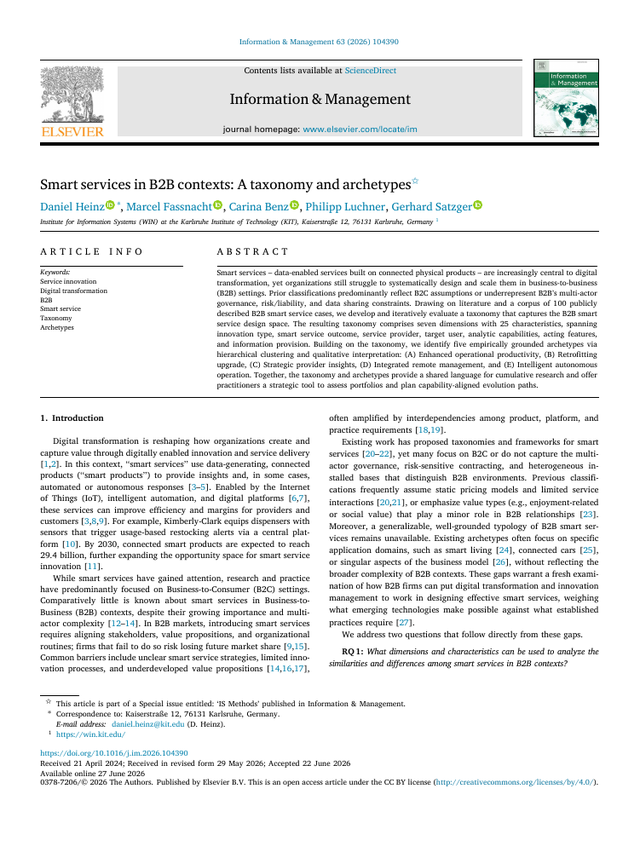
Smart Services in B2B Contexts: A Taxonomy and Archetypes
Information & Management · 2026
Paper preview · CC BY 4.0
© The authors 2026