The work continues after launch
Putting an AI system into production creates continuing work. Someone needs to monitor its outputs as data and use change, help colleagues judge its results, and keep the system working. The projects we studied combined these routines with documentation and reusable technical components, so the knowledge gained could support later projects.
Who leads in each phase?
We found projects where business functions led both the pilot and production, projects where technical teams retained the lead, and projects where responsibility moved from technical teams to a business function. These patterns describe where primary responsibility sits; both sides can contribute throughout. The expertise available within each function appears to shape which arrangement it can sustain.
Who carries the use case forward?
Primary responsibility can stay in one team or move as an AI project enters production.
| Arrangement | During the pilot | In production |
|---|---|---|
| Business-led | Pilot: Business function leads | Production: Business function keeps the lead |
| Handover | Pilot: Technical team leads | Production: Business function takes the lead |
| Technology-led | Pilot: Technical team leads | Production: Technical team keeps the lead |
Technical and business teams can contribute in every arrangement. The question is who carries primary responsibility for the use case.
Technical support and ownership can diverge
In one studied project, an agent prepared briefings for customer meetings. IT rebuilt and integrated the system for wider use, while the account teams kept responsibility for the content it produced. Moving engineering work to IT did not transfer ownership of the use case. Looking only at who builds the software would miss this distinction.
Prepare the receiving team during the pilot
Illustrative application: imagine an agent that drafts answers to supplier queries. Technical staff could test its retrieval and tool use while procurement specialists check the answers against purchasing rules. If procurement will own daily operation, the pilot is also a chance to build the team’s expertise, document the system, and agree when to call technical support. The study does not establish a universally best arrangement.
About the study
Study design and scope
We conducted a qualitative multiple-case study of 14 AI projects across seven large established firms. The systems were customized for internal use, including retrieval-based assistants, agents, and predictive models. We selected projects already embedded in their intended setting or being integrated into it. This definition concerns deployment; it does not establish sustained adoption, financial returns, or other benefits.
Interviews and analysis
Between June 2025 and April 2026, we conducted 15 case interviews and two contextual interviews with senior managers. The interviews were recorded and transcribed. One author led the inductive coding, refining interpretations with coauthors. We first developed the categories from participants’ accounts, then organized them around identifying opportunities, pursuing them, and building capabilities that last beyond an individual project. The resulting framework distinguishes concrete activities from the broader capabilities they support.
Comparing responsibility across phases
The responsibility analysis used 11 projects with enough evidence about both piloting and production. One case offered only a user-side perspective; two lacked sufficiently specific project evidence. Two researchers independently classified responsibility in each phase on a scale from technical to business ownership, then resolved differences by returning to the transcripts. AI specialists embedded in a business function counted on that function’s side. The patterns came from this comparison; the three detailed case examples illustrate them.
What the evidence can tell us
The study describes arrangements found in projects that reached or approached production. It does not compare them with failed projects or show which activities cause success. Most cases rely on one interviewee’s account, and the study reconstructs the transition rather than following projects over time. The sample cannot establish that the patterns cover every possible arrangement. The proposed link between expertise and responsibility remains exploratory, including how teams develop the expertise needed to take over a system.
The paper
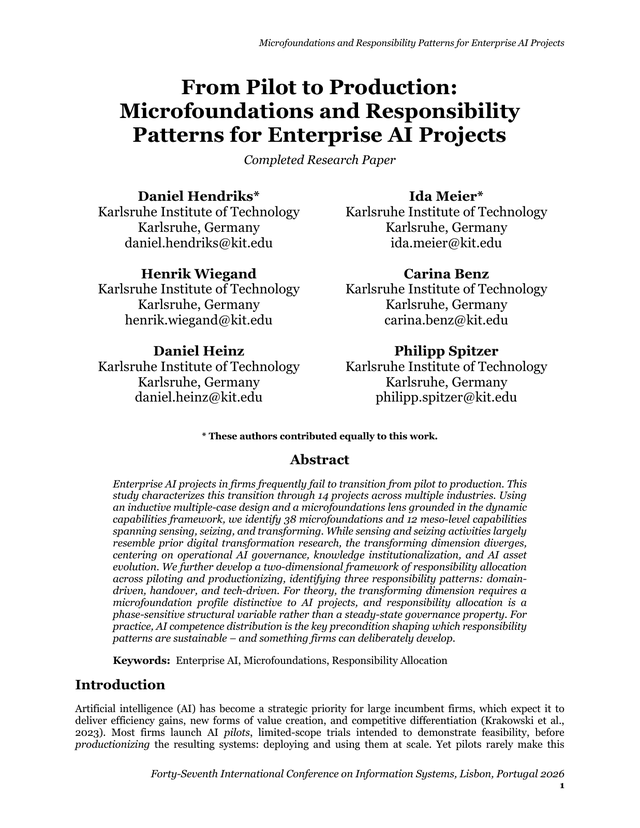
From Pilot to Production: Microfoundations and Responsibility Patterns for Enterprise AI Projects
ICIS · 2026 · Accepted
Author manuscript · KITopen
© The authors 2026 · Noncommercial use only