The tension
Established firms depend on systems built over many years. Those systems can make change difficult, but they also hold the records, workflows, and controls that keep daily operations running.
What the study explains
We studied how manufacturers reconfigured existing systems for new digital activities. Firms used stable operations to support experiments, put accumulated data to new uses, connected new applications through interfaces, and adapted financial routines for new revenue models.
Make more of the systems already in place
Reconfiguration can add capabilities and make more of the existing system base available for new uses.
Existing configuration
After reconfiguration
Further reconfiguration
- Available for new uses
- Constrained by technical debt
Each change builds on the previous configuration. The system base can grow while some technical debt remains: obligations that make change more costly or risky.
Reconfiguration may mean testing ideas on a stable core, using historical data, adding interfaces, or adapting billing for new services. These mechanisms can be combined; they have no fixed order.
An agent that coordinates maintenance
An illustrative extension to agentic workflows: a vibration alert prompts an AI agent to retrieve repair history, call a failure-prediction model, and check compatible parts and production schedules. It proposes a repair window and prepares a work order. If a part is unavailable, it checks alternatives before sending the plan to a maintenance planner for approval.
The workflow depends on a shared machine identity across maintenance, inventory, and scheduling records. Historical failure data supports the prediction model. Interfaces let the agent reserve parts and submit approved work orders while the existing systems maintain stock balances and production commitments. This applies the paper’s ideas about reusing accumulated data and connecting new capabilities through middleware.
A pilot could begin with one machine family and its established maintenance routines. If the manufacturer offers the service under an uptime contract, operating records also need to connect to contract and billing systems.
A practical starting point
Before deciding what to replace, identify the data and routines a new offering can build on. Then make responsibility for the connections between old and new systems explicit. The paper offers explanations for such changes, not a universal migration plan.
About the study
Research approach
We compared five established German manufacturers that had successfully reconfigured their enterprise systems while keeping daily operations running. The study looks back at completed changes to explain how they happened. Cases ranged from agricultural machinery to food-processing equipment, with digital offerings such as remote diagnostics and predictive maintenance.
Evidence and analysis
We interviewed 32 people, including managers at different levels and external partners. Interviews were recorded and transcribed, then checked against company records, field notes, and other documents. For each firm, we reconstructed a timeline of decisions and changes to its systems. Comparing those timelines helped us identify recurring mechanisms: the conditions that enabled change, the actions taken, and the outcomes. We checked alternative explanations and searched for evidence that challenged each mechanism.
What the findings support
The result explains paths that worked in these firms. Because we deliberately selected successful cases, it cannot establish how often reconfiguration succeeds or whether it outperforms replacement. The findings are most relevant where established systems remain essential to reliable operations. The agentic maintenance workflow above is an illustrative application of these ideas; it was not one of the studied cases.
The paper
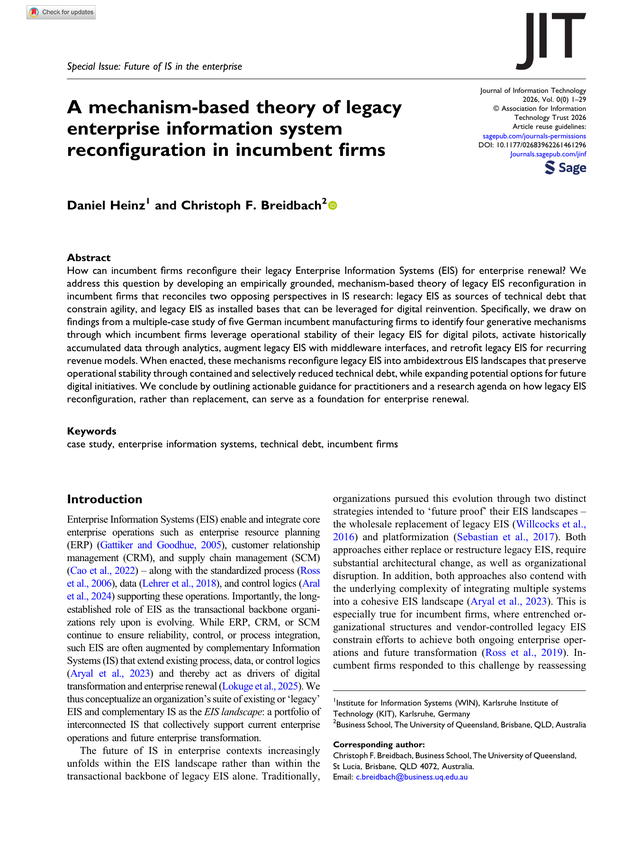
A Mechanism-Based Theory of Legacy Enterprise Information System Reconfiguration in Incumbent Firms
Journal of Information Technology · 2026
Paper preview · CC BY 4.0
© Association for Information Technology Trust 2026