Look beyond one person and one tool
A service usually connects several participants. Customers, employees, and partner firms may all use AI. Understanding their collaboration requires looking at the resources they share and the rules that shape what each participant can do.
What the paper contributes
Our framework describes service networks in which humans and AI systems act together. It explains how the division of work depends on the situation and can evolve as participants change their capabilities and expectations.
Human–AI collaboration extends beyond a pair
People, AI systems, and human–AI hybrids bring resources into a shared service. Their roles depend on the task and the rules around them.
Rules and norms
Laws, policies, and shared practices shape the interaction.
Human–AI hybrid
Roles configured for the task: who decides, acts, and stays in control.
Human actor
The task is performed through human agency.
AI actor
The task is performed through AI agency.
Hybrid intelligent service
Actors combine resources to create value together.
Resources
Skills, knowledge, data, and infrastructure
Following a customer request
Illustrative example: an AI assistant prepares an answer, an employee checks it, and a partner supplies information needed to resolve the request. The service depends on all of those contributions and on agreements about access, responsibility, and disclosure.
A question to take into practice
Who is acting, what resources can they use, and what rules apply? Mapping those relationships is one way to use the framework when discussing a new AI service. This is a practical application of the concept, rather than a method tested in this paper.
About the study
Research approach
This is a conceptual study: we bring existing theories together to explain a problem they address separately. We combine research on human–AI collaboration with service ecosystem theory and research on agency, the capacity of people and software to act and influence outcomes. The aim is to explain how collaboration changes across a whole service network.
How we developed the framework
We connected concepts from these research streams into a framework covering participants, their resources, and the rules governing their interactions. We then worked through scenarios, including elderly care and IT customer support, to examine whether the framework could describe different forms of collaboration. This process led to propositions about how human and AI roles develop and affect the wider network.
What the study can tell us
The framework provides a way to analyze who does what when AI enters a service. The scenarios illustrate its use; they are not field trials. Whether particular arrangements improve outcomes still needs empirical testing, especially in settings where human–AI collaboration is less established.
The paper
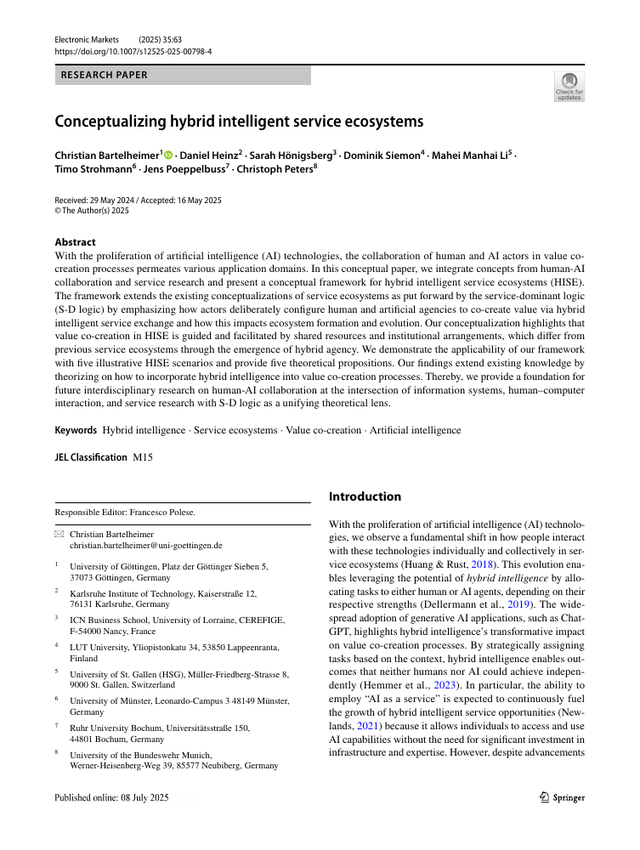
Conceptualizing Hybrid Intelligent Service Ecosystems
Electronic Markets · 2025
Paper preview · CC BY 4.0
© The authors 2025