The decision begins before disposal
A remanufacturer needs to know how a battery was built, used, and repaired. Those records originate with other firms, often years earlier. Choices about component design and access to product history shape what can be recovered later.
Work backward from the future
We envisioned a circular European automotive industry in 2050, then traced the steps needed to get there. The resulting pathway connects better lifecycle data with agreements about who can use it, skills for acting on it, and investment in circular production. Digital tools and those organizational changes develop together.
How the transition could unfold
Data, production, and shared rules have to develop together.
Build a shared basis for change.
2020–2027 in the proposed pathway
- Data and tools
- Record a battery’s lifecycle and make its history accessible through digital product passports.
- Industrial practice
- Design components for disassembly, reuse, and recycling.
- Coordination
- Establish data standards, responsibilities, and regulatory frameworks.
Learn from the batteries coming back.
- Data and tools
- Combine lifecycle records with predictive analytics to inform recovery decisions.
- Industrial practice
- Test take-back systems and use returned batteries to improve circular designs.
- Coordination
- Agree how firms share data and collaborate across the value chain.
Turn isolated pilots into industrial capacity.
- Data and tools
- Extend product passports and forecast component wear and return flows.
- Industrial practice
- Expand remanufacturing and recycling capacity across the value chain.
- Coordination
- Align interoperability standards and incentives across markets.
Keep materials in use across industries.
- Data and tools
- Use shared lifecycle data to coordinate material flows and improve recovery.
- Industrial practice
- Connect automotive, energy, and electronics industries through reuse and recovery.
- Coordination
- Keep adapting governance and regulation as technologies and expectations change.
The aim: a circular, carbon-neutral European automotive industry by 2050. Even a mature ecosystem keeps adapting; raw material inputs and waste do not disappear.
Choosing a battery’s next use
Illustrative scenario: a battery returned from an electric vehicle has uneven wear across its modules. An authorized remanufacturer combines the battery’s usage history with fresh diagnostic tests. A model estimates remaining useful life, while a digital twin tests how it might perform as stationary storage.
That evidence helps the firm choose between a second use, rebuilding the pack from suitable modules, and material recovery. The decision and any replacements are written back to its digital product passport, so the next owner can understand what it contains. This depends on other firms agreeing which history to share and retaining control over sensitive information.
Start with one future decision
Choose a component and ask what a future repairer or remanufacturer would need to know about it. Then work backward: who creates that information, who keeps it accessible, and what would make sharing it worthwhile? The paper’s scenarios offer a way to organize that discussion.
About the study
Research approach
We used backcasting: define a desirable future, then work backward to the actions needed to reach it. Our target was a circular, carbon-neutral European automotive industry by 2050. We developed future images for vehicle design and manufacturing and for recovering value when components finish their original use.
Evidence and analysis
We conducted 14 interviews across two rounds with representatives of eight organizations, then compared the findings with research and industry literature. Interview transcripts were coded into recurring themes. Two expert workshops challenged and refined the future images and the transition pathway. The first included nine research and industry participants; the second included five experts in circularity, automotive technology, and data sharing.
What the findings support
The result is a proposed pathway, grounded in expert judgment and existing knowledge. It does not predict what will happen or demonstrate the environmental gains of a deployed system. Some goals remain only partly quantified, and the pathway lacks an ongoing process for monitoring and adjustment. The battery example above illustrates the future scenario; its decisions would still need technical and economic evaluation in practice.
The paper
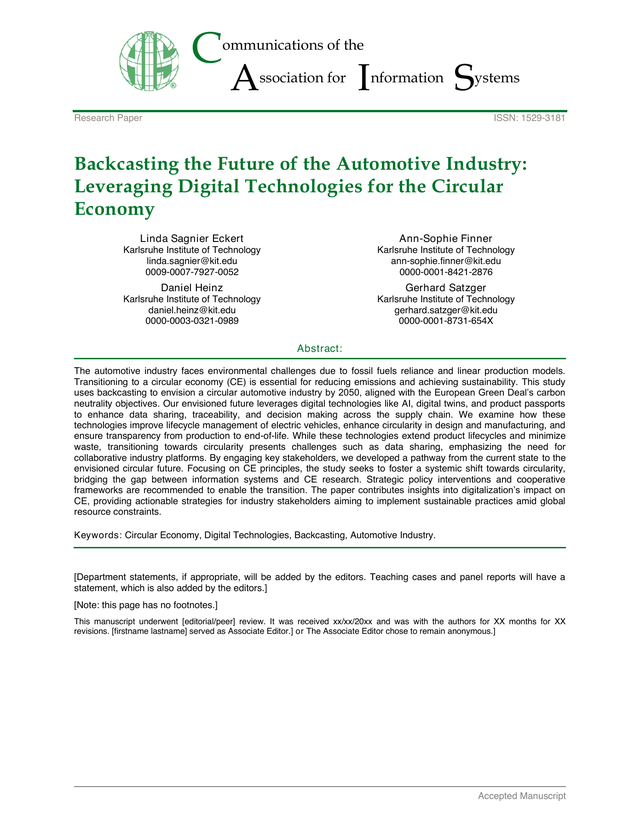
Backcasting the Future of the Automotive Industry: Leveraging Digital Technologies for the Circular Economy
Communications of the Association for Information Systems · 2026
Accepted manuscript · KITopen
© 2026 Association for Information Systems · Noncommercial use only