The problem with agreeable answers
Generic AI assistants can offer quick responses while losing the context of a venture or accepting its assumptions too readily. Human coaches also have limited time and cannot follow every decision between sessions.
What the paper proposes
Interviews with founders and coaches informed requirements for AI coaching systems. The system should help structure the venture, connect assumptions with tests and evidence, and support critical reflection across successive conversations.
What an AI coach should support
Venture work, learning, and reflection call for different kinds of support. Founders keep control of decisions.
Task handling
- Keep work moving
- Turn insights into next steps and keep track of progress.
Sensemaking
- Clarify the venture
- Build and revise a coherent account of how the venture should work.
- Test assumptions
- Make assumptions explicit, plan tests, and use evidence to revise the venture.
Personal development
- Reflect on decisions
- Use questions and constructive feedback to support founders’ judgment.
Founders can accept, revise, or reject suggestions. Desk research and simulations can prepare a test; they cannot replace evidence from the outside world.
Make an assumption testable
Illustrative example: a founder believes customers will pay for a new service. An AI coach could ask what evidence supports that belief and help plan a test. The founder decides how to interpret the evidence and what to do next.
A design principle to carry forward
Keep assumptions, experiments, evidence, and decisions connected. Let founders accept, revise, or reject a recommendation with their own reasoning. These are design proposals intended to support learning, with effectiveness still to be evaluated.
About the study
Research approach
The study uses design science research to define what an AI coaching system should support. In 2025, we interviewed 19 startup founders and eight coaches in Germany across two rounds. Founders described their use of AI and the support they wanted; coaches contributed experience across ventures.
From interviews to requirements
We recorded and transcribed the interviews, then coded accounts of current problems separately from ideas for future support. Comparing founder and coach perspectives helped us group recurring concerns into themes and derive four design requirements. Two researchers discussed the coding and interpretations. The author team checked that each requirement could be traced to the interviews, was consistent with the others, and could guide system design.
What the evidence supports
The findings offer a starting point for designing AI coaching in early technology ventures, based largely on university-linked coaching settings. Their usefulness in other settings still needs testing. The paper develops requirements; it does not evaluate a deployed AI coach or establish improvements in founders’ judgment or venture success. Building and evaluating systems is the next research step.
The paper
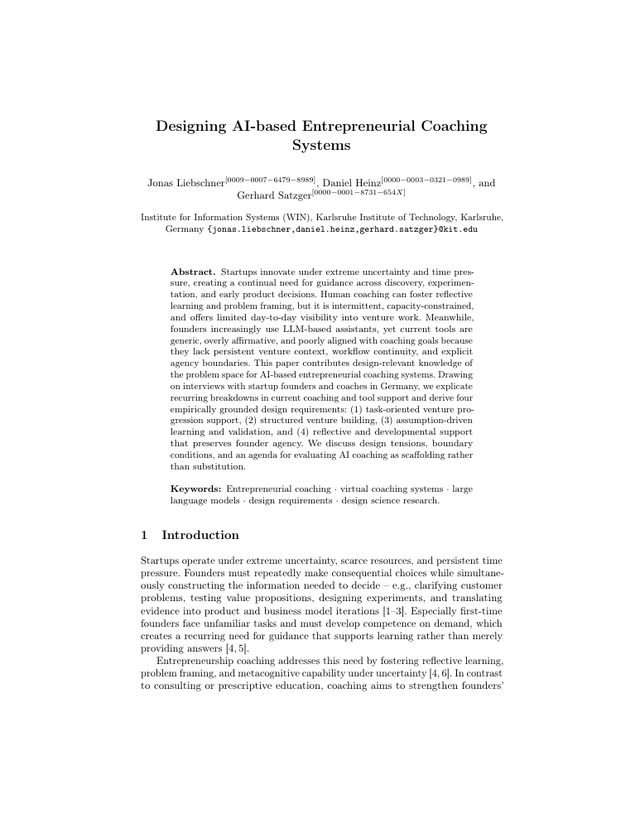
Designing AI-Based Entrepreneurial Coaching Systems
DESRIST · 2026
Accepted manuscript · Published version
© The authors 2026, under exclusive license to Springer Nature Switzerland AG